
What the Failed Elevance-Louisiana Blue Deal Still Explains About Blues Consolidation in 2026
A $2.5 billion sale collapsed on Mardi Gras night two years ago and ended a 28-year for-profit playbook. The nonprofit affiliation wave that replaced it is the story of Blues consolidation now.


Upward Growth is a health plan market advisory firm. Our weekly newsletter covers payor market strategy, regulatory shifts, and go-to-market insights for health tech vendors, investors, provider organizations, and consultancies competing in the health plan market.
🤝 Work with us on payor market strategy: Contact us
🟦 Connect with the author, Ryan Peterson, on LinkedIn.
🎧 Listen to the Upward Growth Podcast: Apple | Spotify
📰 Newsletter sponsorships: Learn More
A note from the authors: This is the first in a series called Inflection Points. Healthcare in 2026 is as fragmented and confusing as it’s ever been, and it got that way one messy decision at a time, with butterfly effects nobody saw until years later. This series goes back to those decisions, looks at what everyone in the room thought they were deciding, and reads them against the record they produced.
These pieces aren’t critiques of the people or the organizations. The decisions were made by serious people, under real pressure, with incomplete information, which is the only way decisions ever get made. We’re not here to tell anyone they were wrong. We’re here because the record is in now, and the record is more interesting than the verdict.
The Elevance-Louisiana Blue deal is the first entry because it’s where the for-profit Blues conversion path, which had run through 14 states since 1996, came to an end. What’s replaced it, a wave of nonprofit affiliations, is where Blues consolidation actually happens now.
Ryan writes Upward Growth, a newsletter on how health plans buy, operate, and make decisions. Andrew Tsang writes long-form narrative pieces on healthcare’s structural moments. We started talking after Andrew read the Upward Growth piece on Blues consolidation, and kept landing on the same thing: the moments that shape a market decide more than the people in them realize at the time.
If reading these makes the market you’re operating in a little more legible, we’ll have done what we set out to do.
Ryan and Andrew
Mardi Gras Night
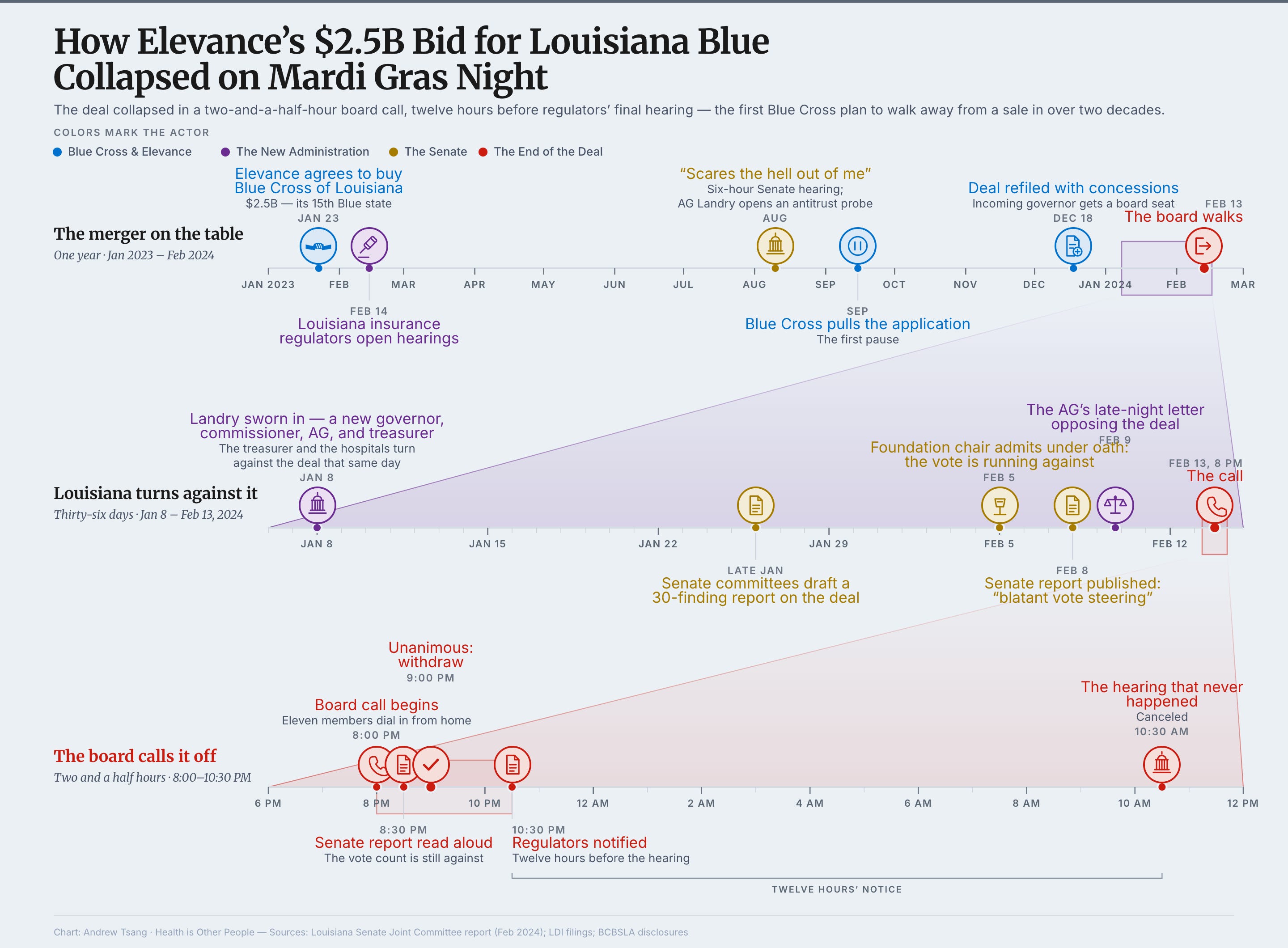
Mardi Gras night in Louisiana belongs to the krewes - the private clubs that spend all year building floats so they can ride them masked through the city, throwing beads to strangers, on a single night. On February 13, 2024, while their floats were still rolling through New Orleans, eleven people who were nowhere near a parade dialed into a conference call to decide a $2.5 billion question: whether to sell the state’s largest health insurer.
From the street a parade looks like chaos. It is one of the most organized things Louisiana does - routes permitted, rolling order scheduled months ahead, every float built and owned by a club whose members paid for it. On Fat Tuesday the krewes hold the city until midnight, when carnival ends and Lent begins.
They had dialed in from wherever the holiday found them — home offices, parked cars, conference rooms borrowed from other firms. The board of Blue Cross Blue Shield of Louisiana was running a club of its own: 95,000 policyholders who technically own BCBSLA and pay their dues on the first of the month. The single agenda item was whether to walk away from a deal that would have sent 91% of its proceeds to a foundation and 9% to those 95,000 owners.
The buyer was Elevance Health — the country’s second-largest insurer, and the company behind Anthem, the name on insurance cards in fourteen states. The template it was running was older than the company itself: the 1996 Blue Cross of California conversion playbook, used state after state since and never once reversed. The CEO of BCBSLA was a physician named Steven Udvarhelyi, who for thirteen months had been the public face of the deal - in front of legislators, hospital lobbyists, two attorneys general, two insurance commissioners, and the new governor’s advisory council. Thirteen months is a long time to run that gauntlet.
By Mardi Gras night the deal was already in trouble. On the table was a senate report with thirty distinct findings - what Sen. Patrick McMath would publicly characterize as “blatant vote steering and monetary enticement.” Eight days earlier, board member Tim Barfield had testified under oath that the policyholder proxy vote was running against the deal “by a couple of percentage points” - a hearing someone close to the deal would later describe as “not your typical legislative hearing” but “an organized action.” The proxy consultant read the latest count. Still running against. The lawyers stayed on mute. For an hour, the board listened to itself.
That language - vote steering, intimidation, enticement - is the language of elections, not corporate proxies. Which is, on paper, exactly what a mutual policyholder vote is supposed to be.
The vote, when it came, was a formality — eleven voices in turn, none objecting. They notified the Department of Insurance at 10:30 that night, which canceled the next morning’s hearing before the next morning came. Whether the eleven then poured a drink or went to bed to avoid one, the record does not say.
Outside, the krewes were still rolling.
Twelve hours separated that board call from the hearing where the buy-side lawyers expected to close. In the 28-year history of Blue Cross conversions, no deal had come this close to the wire and walked. They die in court, months in advance. The $37B Aetna/Humana and $54B Anthem/Cigna deals were each killed by a federal judge in early 2017, and each walked the morning its ruling landed. They do not die on a Tuesday night, ten and a half hours before opening arguments.
The deal didn’t just fail - the template did. A playbook the entire insurance-M&A world had followed since 1996 ended on a conference call no one outside the room heard. The deal itself had lived exactly one parade season: first heard by the Department of Insurance on February 14, 2023; the hearing it died avoiding was set for the same year The morning after was Ash Wednesday — fittingly, Valentine’s Day that year. Louisiana had jilted its suitor and walked into Lent on the same morning, and some of its people were out celebrating. It takes the inside of this deal - and the outside - to understand why it failed.
Why Udvarhelyi Wanted to Sell a Plan That Wasn't Failing
By every conventional market read, this should have been a closing.
To understand why, you have to start with the structural problem that defined every Blues conversion attempt of the 1990s. Mutual insurance companies are technically owned by their policyholders, which is what makes converting one to for-profit politically radioactive. You are, in a literal sense, taking something that belonged to millions of members and selling it to shareholders. Every Blues conversion attempt in the 1990s ran into the same wall: who gets the money, and on what authority. California found the answer in 1996, and the answer was the foundation. Capitalize an independent charitable entity with the conversion proceeds, give it a health mission tied to the state, and the expropriation argument loses its teeth. Policyholders don’t get cash, but the value they’re presumed to have collectively built is ring-fenced in something that still serves them.
Once that answer existed, the whole question of conversion changed. Blue Cross of California’s 1996 conversion to WellPoint Health Networks capitalized two charitable foundations with roughly three billion dollars in stock. The California Endowment grew into the largest health-focused private foundation in the state, and the California HealthCare Foundation became one of the most influential health policy grantmakers in the country. The deal closed in eighteen months. Once that proof point existed, every subsequent conversion ran on a version of the same playbook. Anthem (Indiana, converted) acquired Trigon (Virginia, converted) in 2002. Empire BCBS in New York converted in 2002, with 90% of proceeds redirected to the HCRA fund of George Pataki, New York’s combative former governor, and only 10% to a foundation, a wrinkle that revealed how thoroughly state politics had absorbed the model. WellPoint and Anthem merged in 2004. WellChoice was absorbed in 2005. Georgia, Missouri, Wisconsin, Maine, Colorado, Connecticut, and Kentucky followed in some form. What looked like M&A momentum was actually a working political answer to the one question that had killed every prior attempt, and the answer kept finding new states to apply it in.
When individual deals did die, they did so on procedural grounds within the same framework. For example, Maryland Insurance Commissioner Steven Larsen rejected the CareFirst conversion in March 2003 in a scathing decision finding the price unfair, the board’s process compromised, and the executive bonuses excessive. So while he rejected the deal in front of him, he did not reject the model. By 2004, conversion activity resumed.
Louisiana 2024 fit the rubric exactly: a $2.5 billion price, a multibillion-dollar foundation as the political release valve, a mutual-to-stock conversion mechanism, and an established acquirer with fourteen Blues state licenses already on its balance sheet. File early, propose a generously capitalized foundation, accept rate-review concessions, run the regulatory gauntlet, close. The structure was twenty-eight years of precedent compressed into a single transaction.
The deal had every market signal a 2010s playbook would have wanted. What it didn’t have was 2020s politics.

What Changed in 28 Years
The buyer in 2024 was running a playbook that traced back to 1996 and had shaped Blues consolidation ever since. The playbook had carried every prior conversion to a close, and for its first decade it kept working: the foundation absorbed the proceeds, the newly for-profit Blue kept its familiar brands, and members’ premiums didn’t visibly diverge. The model didn’t just hold — it grew, proving itself in market after market.
For 28 years, the WellPoint, then Anthem, now Elevance playbook shaped Blues consolidation. The conversion wave itself was clustered in the first decade: California in 1996, Virginia and New York in 2002, Georgia, Missouri, Wisconsin, Maine in the years after. After the CareFirst rejection in 2003, no acquirer attempted another nonprofit-to-for-profit conversion until Elevance came for Louisiana twenty years later. And not one of the fourteen prior conversions had ever been reversed.
The providers had the receipts. Doctors and hospitals spend their working lives on the receiving end of an insurer’s claims decisions, and Louisiana’s had a quarter-century of Elevance’s to look at. When the Louisiana State Medical Society (LSMS) voted against the deal, it didn’t do it in the way professional societies usually do - with a position paper and a sigh. The LSMS voted no as a policyholder, exercising its equity claim in BCBSLA that appears to be unprecedented. The Louisiana Hospital Association sent the Department of Insurance a letter cataloging $26 million in Elevance fines since 2019, most of them for denying Medicaid claims and stiffing providers on payment timeliness. In 1996 the buyer was WellPoint, ten minutes old, with no record to read. By 2024 the record was a quarter-century long, and it did not flatter the company asking 95,000 Louisianans to trust it.
The foundation looked like a shell. When a nonprofit insurer converts, the law won’t let the proceeds disappear into the buyer’s balance sheet; they capitalize a charitable foundation meant to serve the same public the insurer did. Louisiana’s was to be the Accelerate Louisiana Initiative, $3.1B promised for state health equity - a number that ought to disarm critics (it didn’t).
The deeper problem was the track record. California’s two conversion foundations spent the intervening decades doing what foundations do well — research on uninsured Californians, benchmark reports on health equity, multi-year grants to community clinics and advocacy organizations. These are pretty standard public health advocacy moves. But the objection was what it did not do: roughly 1.8% of grantmaking went to insurance subsidies, while the other 98% went to research, advocacy, and education that did not lower a single Californian’s monthly premium.
For a Louisiana policyholder watching their monthly premium rise every year, it was a practical choice between researchers studying inequity and a check covering this month’s bill - it was the difference between being studied and being served. When BCBSLA proposed the Accelerate Louisiana Initiative — the same three billion dollars, governed by four insiders — Louisianans did not have to imagine what could go wrong. They had California’s twenty-eight-year operating record telling them their premiums would keep going up no matter how many grants the foundation made.
The vote was the wrong shape. A mutual is owned by its members, and selling one needs their consent — a vote that looks like a corporate proxy but runs with the energy of an HOA election — and by February 2024, that governance had developed a constitutional problem. The buckslip BCBSLA mailed to its own members was titled “Grant your Proxy FOR our Plan of Reorganization.“ Senate Joint Committee findings documented “vote steering,” “voting integrity,” and “voting confusion” problems, including ballot design that favored the “FOR” option.
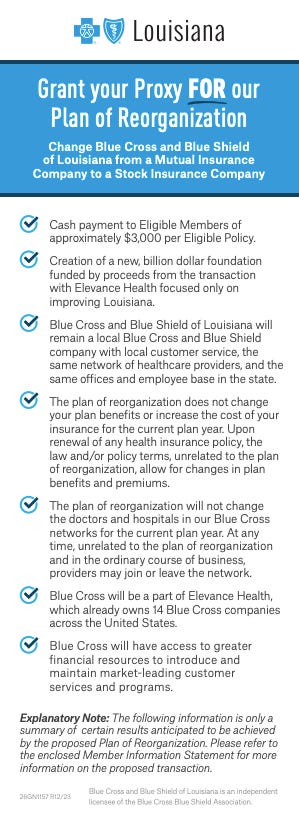
This changes the conversation from insurance wonkiness to something with more teeth: undemocratic voter steering. Whether a foundation is well-designed, whether Medicare Advantage scale is real, whether the fines are damning or routine — those are policy questions, with defensible arguments on both sides. Whether 95,000 people had been steered toward a vote about their rightful ownership of their own insurance company - that is no longer a policy question. It is a question about democratic process. A policyholder vote is, in the most literal sense, the only mechanism the owners have to consent to what happens to what they own. Engineering that vote is not procedural sloppiness. It has a different name in any other context - and that name is American.
The deal had to win both the substance and the process at once; the coalition against it needed only the process — and a stacked ballot handed them that.
The mutual identity question. The deal had walked into an election year, and the machine of state elections will steamroll corporate maneuvers. Jeff Landry had investigated the deal as attorney general - “as it currently stands, it’s a bad deal” - then won the governorship in October, and as governor-elect convened a private advisory council on the sale, its members instructed not to talk publicly about the meetings. BCBSLA sat on that council, and the deal it re-filed in December read like a list of concessions to the people in the room: the foundation re-incorporated in Louisiana, a board appointment for the governor, an observer seat for the incoming insurance commissioner. The deal team had negotiated with everyone it could see.
Then January 8, 2024: a new governor, attorney general, insurance commissioner, and state treasurer sworn in at the same noon ceremony - and the opposition began to roll. The new treasurer first: John Fleming, a family physician from north Louisiana, came out against the deal before his own inauguration day ended - “join my fellow physicians... vote no.” The hospital association voted no the same day. The senate committees by late January, drafting what became the thirty findings. The attorney general - the new one, holding Landry’s old office - on February 9, in a letter sent late at night. Thirty-six days from the noon ceremony to the board call, the moves to defeat the merger steadily marched forward. Same-day denunciations are not improvised; like the floats, they are built in the off-season and rolled out for the parade. The deal had made its concessions to the people with titles, and the coalition rolling past it had no one to negotiate with. A month after taking office, in front of the Senate Joint Committee, Fleming delivered the line he is most quoted for: “Their interests will be maximizing profits day in and day out and getting back the $2.5 billion purchase price.”
Convert a mutual to a stock corporation owned by Elevance shareholders and the policyholders lose the company they own. The deal priced that loss at 9% of the proceeds — about $3,000 per eligible policyholder — with the other 91% going to a foundation they did not control. Insurance is a way of pooling exposure to risk among people who share something — a state, a community, a profession, a family. That split made the pool visible enough that the people who owned it walked away from the sale. The LSMS called it “detrimental to put our patients’ health at risk to achieve exorbitant profits for a corporation.” That language sounds populist until you remember the people saying it were also, technically, the people selling. A mutual cannot sell itself without selling against itself.
What was different in 2024 was not the deal but the world it had to land in: most Americans now interacted with the Blue Cross brand through a denial code, and a sentence containing “three billion dollars” and “controlled by four insiders” read as a populist trigger rather than as a gift.
The M&A playbook written in 1996 was the answer to for-profit insurance. By the time it came to Louisiana in 2024, it had become a question — one the man who carried it to the board had spent thirteen months sure he’d already answered.
The Four Forces Behind the Deal
From inside the deal, it never looked the way the opposition was reading it. Steven Udvarhelyi was a physician who had run BCBSLA since 2016, and he had been watching the numbers move in one direction for years. The plan he ran was not failing. Fitch had rated BCBSLA among the most profitable Blues in the country. Surplus was up 38% over five years. The company had been profitable in four of the prior five years. By the standard measures of a regional health plan, BCBSLA was holding its ground. The case for selling was in the slope of the line, not the value of it.
Four forces shaped what he was watching:
The most profitable book was disappearing. Large and mid-sized employers had spent two decades migrating from fully insured products to administrative services-only (ASO) arrangements, where the employer carries the medical risk and the plan earns a fee. ASO economics are an order of magnitude thinner than fully-insured economics. Every employer that crossed over took the most profitable kind of revenue BCBSLA had with them, and almost none ever crossed back.
The market was shrinking, and BCBSLA was concentrated in it. Roughly 90% of BCBSLA’s revenue came from employer-sponsored coverage. The employer-sponsored share of the Louisiana market had declined by 20% over the prior decade as employer count shrank, public coverage expanded, and the remaining employer book itself moved toward ASO. The plan was leaning more weight on a segment that was getting smaller and thinner at the same time.
Medicaid had become a national game. UnitedHealthcare and Aetna had built Medicaid managed care operations across dozens of states, with the data, technology, and operating leverage that comes with running ten million Medicaid lives at once. BCBSLA was running its Medicaid plan in one state. In every state procurement cycle, the national plans showed up with capabilities BCBSLA could not match and priced against a cost base BCBSLA could not approach.
The infrastructure floor kept rising. Udvarhelyi’s read on the runway was that by 2025 competing in any line of business would require investments in claims platforms, AI-enabled utilization management, member engagement technology, and analytics infrastructure that no single-state plan could build in time. Elevance had it. HCSC had it. BCBSLA did not, and the gap was widening every year.
By 2022, the trajectory had become unambiguous enough that the board authorized Udvarhelyi to find a partner. The deal in front of them in 2024 was the result. Udvarhelyi made the same argument everywhere he was allowed to make it, telling Louisiana lawmakers in 2023 that "the forces at play in the marketplace, the inevitable forces of consolidation, will happen and we will have to consolidate from a position of weakness." The deal was a chance to consolidate from a position of strength instead. The price would be better, the terms would be better, the foundation would be larger, and the employees and members would be protected by leverage BCBSLA would not have in five years.
This was a market intelligence read on where the business was headed. The opposition was reading where the business was. Both reads can be true at the same time. The structural tragedy of the Louisiana deal is that nobody in the room was actually arguing with anyone else. Instead, they were arguing about different timeframes. Resolving that would have required Udvarhelyi to make the case for the five-year trajectory directly to the providers, members, and legislators reading 2024 conditions, and the opposition pressure-testing the trajectory rather than rejecting the present-day terms it produced. That conversation never happened.
Two Years Later, Most of the Blues Are Under the Same Pressure
The BCBSLA-Elevance deal died two years ago, and the case Udvarhelyi was making to his board has largely held up. In August 2025, BCBSLA began rolling layoffs through attrition and position eliminations, citing rising medical costs and the expiration of enhanced ACA subsidies. Louisiana’s 2026 individual market rate filings came in with a weighted-average increase of around 21.9% across all carriers, later revised upward to 23.4%, the largest annual increase the state has seen in years.. The fully-insured employer book Udvarhelyi had been worried about kept shrinking. And the operating margin, which had been a slim positive 0.1% in 2024, dropped to -4.3% in 2025. The forecast he was selling against in 2023 is the present BCBSLA is operating in now, and the exit ramp he tried to take is closed for the foreseeable future.
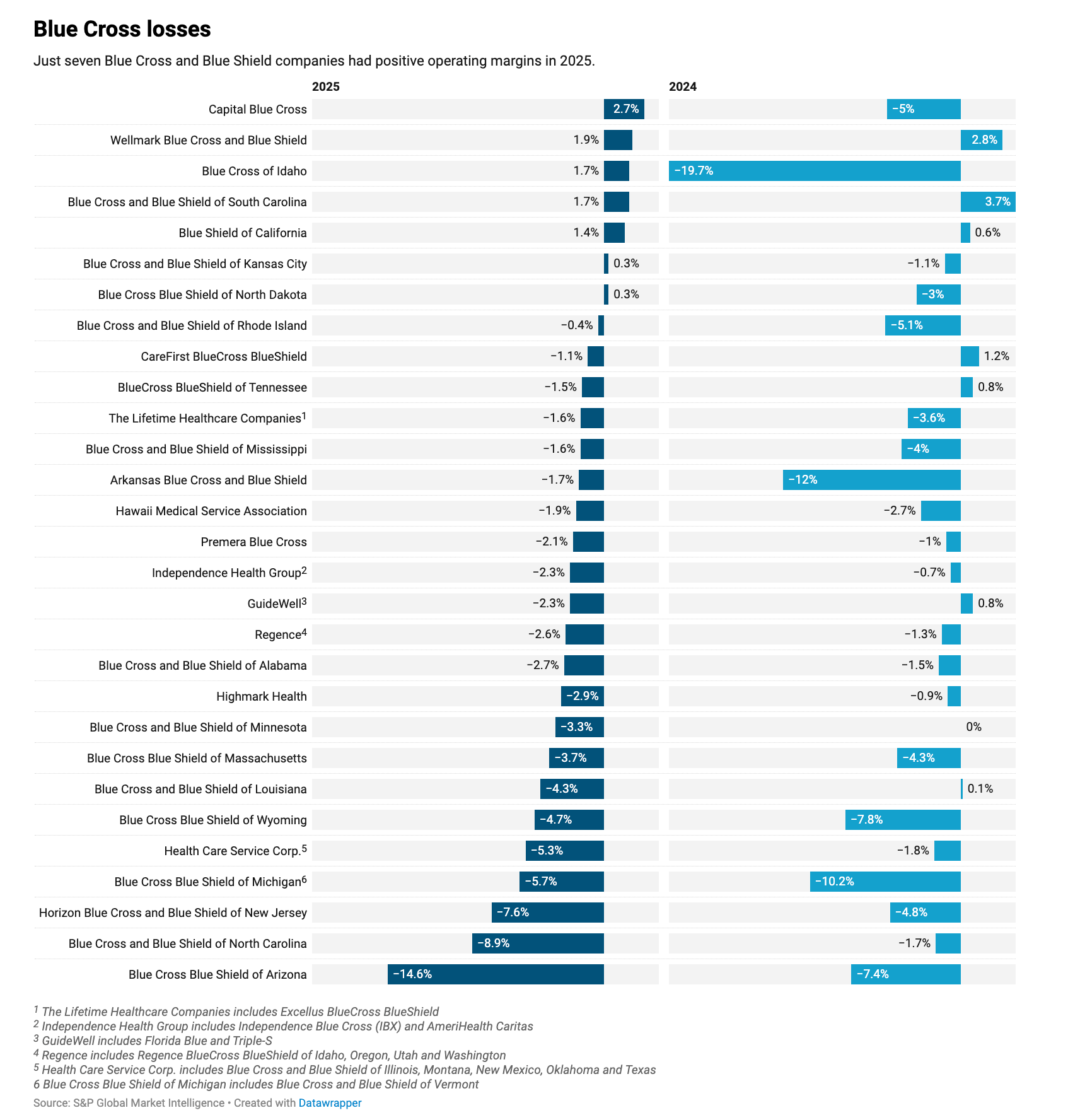
Only seven Blues posted positive operating margins in 2025, down from eight in 2024. The for-profit acquisition path that ran for twenty-eight years is closed, but consolidation isn’t. It changed shape, and the chart shows the new shape working. Wellmark, the BCBS Michigan affiliate, posted +1.9%. Blue Cross of Idaho, which restructured into a mutual holding company, posted +1.7%. BCBS North Dakota, which joined Cambia in early 2026, posted +0.3% in its first year. Arkansas, which announced its Cambia affiliation in 2025, improved from -12% to -1.7%. The plans furthest from affiliation are the ones bleeding most: BCBS Arizona at -14.6%, North Carolina at -8.9%, and BCBSLA itself at -4.3%. The exception that proves the rule is BCBS Michigan, the parent itself, at -5.7%, expanding its affiliations across Wellmark, NextBlue, WyoBlue, and Vermont while bleeding at home.
Cambia spent the last twelve months absorbing two struggling Blues. HCSC closed a $3.3 billion acquisition of Cigna's Medicare business in March 2025, with 71% of its MA enrollment now in HealthSpring rather than in the legacy Blues plans. Highmark closed its Blue KC affiliation on March 31. BCBS Michigan is steadily building a five-state footprint while its own balance sheet deteriorates. The parent organization is becoming the operating unit. The local plan is becoming the brand the member sees on the card.
If you invest, the Elevance-style roll-up thesis is off the table, the deal flow you’re underwriting is now affiliations and shared-services consolidation, and the second-order opportunity is in the companies sitting downstream of the consolidated parents. If you sell to Blues, map your pipeline and installed base to parent organizations this quarter, because the plans most likely to affiliate in the next eighteen months are the ones sitting in the bottom third of that chart. If you advise plans, conversion advisory is a contracting market and federation advisory is the growth market. If you run a provider organization contracting against a Blue in the bottom third, the parent that absorbs them will have rate reference data across its footprint and less institutional incentive to preserve a local relationship that doesn’t perform.
Two years after the BCBSLA-Elevance deal collapsed, the question isn’t whether the Blues system is consolidating. The question is whether the plan you sell to, contract with, model against, or advise is going to be the one absorbed, the one absorbing, or the one bleeding out on a standalone basis.
Close on Mardi Gras Night
Louisiana didn’t answer the question. It surfaced it. And the question — who is this insurance for? — has been forming longer than anyone in the BCBSLA boardroom on Mardi Gras night had been alive.
What has changed in ninety-seven years is not the pool — structurally, BCBSLA’s policyholders own the same thing its earliest member did — but what people are willing to do with it. Three live answers now compete for the role.
The for-profit answer. Insurance is a financial product. Shareholders accept risk, accumulate scale, and operate as one publicly listed company across many markets. This is the answer Elevance offered Louisiana, and the scale behind it is real. The Epic implementation BCBSLA was paying for out of its own pocket, Elevance had already amortized across forty-seven million members. The GLP-1 negotiations absorbing eight figures of regional plans’ annual budgets, Elevance ran through a national PBM with leverage no single-state plan can match. As of 2026, no for-profit acquirer has announced another Blue Cross conversion attempt. The path is not legally closed — it is politically exhausted.
The mutual answer. Insurance is a communal arrangement — owned by its members, governed locally, answerable to its community. This is the answer Bryan Camerlinck — Udvarhelyi’s successor, named CEO three months after the deal died — was testing under the Louisiana Blue rebrand: restructure internally, expand the profitable segments, outrun the trajectory before the scale gap becomes operationally fatal. The first two years of that bet have looked like Udvarhelyi’s February testimony reading itself back. Across 2024-2025, at least seven Blue Cross plans reported net losses.
None of these plans ran the business badly. The business has gotten harder for plans without national scale — exactly what Udvarhelyi predicted. The mutual answer is what Louisiana chose, and what Louisiana is now defending, with the data piling up on the side it just argued against.
The federation answer. Insurance is a multi-state nonprofit federation. Local plans keep their boards, brands, and mutual status, but share the infrastructure single-state plans cannot afford to build alone — claims platforms built once and deployed everywhere, compliance operations whose costs scale with rule volume rather than member count, drug procurement run through combined member volume. Cambia is deploying it in real time — North Dakota in February, Arkansas pending — with Highmark and BCBS Michigan running their own versions. Of 34 Blue Cross licensees, only eight posted positive operating margins in 2024. Most of the rest are choosing some version of the federation answer. Louisiana has not.
Underneath the three answers is the question itself: what is insurance supposed to do? In 1929, it pooled risk between a Dallas hospital and 1,300 of the city’s schoolteachers. In 1996, it became an asset class opening to public-market capital. In 2026, with seven Blue Cross plans posting losses and GLP-1 spending climbing thirty percent a year, the question has stopped being abstract: whoever owns the pool decides what the pool is for. The deal Louisiana refused was a vote on who that should be — 91% to four insiders, 9% to the 95,000 people who actually owned the company. The deals every other state has yet to make are votes on the same question.
What Mardi Gras night closed was not the deal, but one of the answers — and the next essays in this series profile the answers still competing for the role.
The frameworks in the weekly Upward Growth newsletter help health tech sales and marketing teams navigate payor conversations as the market continues to shift.
If your colleagues are in those conversations, they should be reading this too.
💰 Invest In Your Team with a Paid Subscription.
💡 Pro tip: Many subscribers expense Upward Growth through their company’s professional development, training, or learning budget. Here’s a one-minute email template to get your manager to approve expensing your subscription.
 | A guest post by
|